


The GoB CLLG Policy aims to create a conducive atmosphere where empowered communities collaborate with the Local Government to create local development plans that align with community needs. This partnership also focuses on implementing sustainable poverty reduction strategies through developmental investments that enhance social service delivery. The CLLG Policy of the provincial Government will be implemented through a range of rural and urban development programs initiated by the GoB. These programs aim to foster the following:
The GoB CLLG Policy and its associated development programs adhere to a regulatory framework established by the provincial Government, which encompasses various aspects.
The GoB CLLG Policy and the CLLG development programmes are fully aligned with the existing body of GoB Policies2, in particular, the Government of Balochistan Local Government Act, 2010 as amended 2022, the GoB Gender Equality & Women’s Empowerment Policy (2020 - 2024), the Balochistan Public Private Partnership Act, 2018, the Balochistan Finance Act, 2020, Local Council (Budget / Fiscal Accounts / Transfer) Rules 2023, and the relevant Balochistan Rules of Business, 2012.
The Balochistan Local Government Act, 2010 as amended 2022, Section 87, explains that “Provided that a Local Council, subject to the approval of the Local Government Board, may engage Registered Community-Based Organizations (CBOs) / Community Institutions (CIs) in its local area development or execute such projects funded by the Donor Organizations / Agencies.”
The CLLG Policy is an elaboration of Section 87 of the Balochistan Local Government (Amended) Act, 2022. Furthermore, the CLLG Policy complements the development planning functions by Union and District Councils as provided in BLGA 2010.
The CLLG Policy distinguishes between initial payments, operating costs, and capital costs for approved projects in accordance with budget and accounting rules. The government will implement a budget, accounting, and auditing system compatible with the PFM system and financial systems of all development partners. The policy calls for flexible financial measures to fund social mobilization support interventions for socio-economic well-being and poverty alleviation. The procedures should be clarified according to government's financial regulations. Future development partners can be budgeted for community mobilization projects, but alternative funding channels may also be used depending on specific circumstances. These may be accommodated under the mandate, supervision, and implementation arrangements of the policy.
In addition to the regular audit by the Accountant General Office, continuous financial and performance audits of the overall intervention and related systems and processes shall be conducted by an auditing firm chosen from the list of approved category-A audit firms maintained by the State Bank of Pakistan (SPB) or by the Government department / institution as approved by PCRC.
The CLLG Policy and the Policy Framework provide a system to regulate the eligibility of Community Institutions (CIs), including a competitive selection of third-party community mobilization NGOs, the self-prioritization of community projects, and the transparent procedure for selection of prioritized community proposals for funding and implementation.
The GoB CLLG Policy provides guidelines for the institutional setup to implement the CLLG Policy at the provincial and district level. This institutional setup specifies the mandate, roles of the institutional entities, and their rules of business (RoB) / ToRs to implement the CLLG Policy and possible rural / urban CLLG development programmes. To implement the CLLG Policy and to manage the possible GoB CLLG development programmes, provincial and district management structures be established with responsibilities for laying down the budget and implementation systems of the CLLG development programmes, the M&E protocols and systems, including the provision of third-party evaluations and audits to assess the effectiveness and relevance of the programme outputs, outcomes and impact delivered.
A three-tiered institutional setup (Figure-2) is envisaged to implement the GoB CLLG development programmes, whereby:
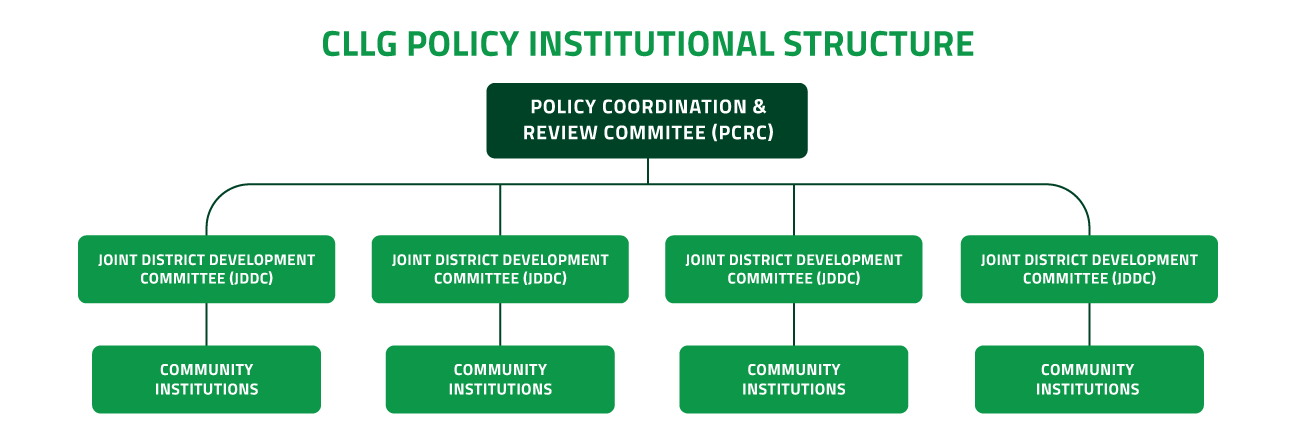
In the context of Balochistan, the CLLG Policy and CLLG Development Plan adopt an effective and adaptable approach that enables the Confucius Institute and the local government to manage the scheduled activities. Evaluating the competency of CLLG program participants will demonstrate their ability to perform and achieve assigned tasks. Through the professional development process, these roles and responsibilities are promoted in accordance with the CLLG process. In order to implement community ownership (CM/CE) in the government system, the government will establish and encourage the Balochistan Rural Development Academy (BRDA) to play an important role in the planning and implementation of social empowerment activities in the affected areas. and government officials, administrative and executive agencies to better understand and focus on the needs of the region and to be able to prepare and coordinate development plans for local government, regional development plans and GoB communities. Leading Local Governance (CLLG) development programs. BRDA will support and enhance the registration capacity of CI and encourage and empower community organizations and regional organizations/community representatives, especially in districts/UCs/MCs and villages/constituencies, to express and organize their CI needs and make suggestions to increase public Services sector, working within the development policies of the government CLLG, implementing the socio-economic policies of the CLLG to empower the people; Social Mobilization (SM), Income Generation Grants (IGG), Community Investment Fund (CIF), Technical Vocational and Educational Training ( TVET), Adult Literacy Centers (ALCs), Community Physical Infrastructure (CPI) Programs, etc. Work in accordance with CLLG policies.
The LG&RDD has developed the MEAL framework for monitoring, reporting, feedback, and learning in CLLG development programs in Balochistan. The framework measures progress in achieving policy goals and allows for corrective adjustments. It also identifies best practices and documents learnings for system development. The MEAL Framework is embedded in local government systems and includes mechanisms for regular reporting and citizen feedback.


This website has been produced with the assistance of the European Union. The contents of this website is the sole responsibility of CLLG Policy Implementation Unit/LGRDD